
LESSON TOPICS:
- Purpose
- Genre
- Audience
- Stance
- Rhetorical Situation
WRITING ESSENTIALS
When we write, whether we know it or not, there are certain things that shape our text. We go through a process to figure out what we are trying to say, why we are trying to say it, whom we are speaking to, and what is the best way to express it. This lesson will define the terms related to this process and will discuss just how they act as influences to our writing.
PURPOSE
When we think of the word purpose, we tend to think of what our intent is. Our goal. When we practice a certain skill, our purpose is to get better, or to master that skill. We have something we are trying to accomplish and we take steps to reach that goal. The same goes for our writing- whenever we write, we have a purpose for that text. We are trying to accomplish something when we write. To figure out what our purpose is, we should be asking ourselves, why am I writing? What do I hope to accomplish through this text?
All texts can be broken down into three categories when we talk about purpose:
1. Inform, 2. Entertain, 3. Persuade
Sometimes we write to demonstrate what we know about a subject. We want to share that knowledge with someone else, either to inform them about the topic, or to show what we know about it, as in the case of a research paper for a class. We may not be trying to teach our audience about the topic because they are familiar with it, but we want to inform them about how much we know about it. Sometimes we want to share information with someone who does not know about a subject. Maybe an event happened and we relate the details of that event to someone who was not aware of it. All of these are examples of us trying to inform our audience about a topic and it is one of the reasons why we write.
The second reason why we write could be to entertain. Examples of this type of writing are easy to come by- when we think of writing meant to entertain we think of stories, novels, comic books, poems, plays, etc. Many times we think of works of fiction. And these examples very definitely fall into this category. Many of these texts are written for the purpose of entertainment. But works of non-fiction can also fall into this category. For example, sports articles or celebrity gossip columns, while reporting things that have actually happened are works of non-fiction, still are written with the purpose of being entertaining. We read material like this for our own personal pleasure. Another way to think of how this purpose works is that it is meant to invoke some sort of emotional connection and/or reaction in the reader. That is what makes it entertaining.
The third purpose for why we write would be to persuade. When we do this, we are trying to get our audience to see an issue from our perspective and hopefully convince them to consider what we are arguing for. We are giving our opinion on a topic and backing up that opinion with reasons why it is valid- again, in the hopes of persuading our audience to consider our position. This type of writing is very common in academic courses. It is a type of writing that many classes focus on, whether it is an actual argumentative text, a debate, or an analysis (when we analyze something we are giving our perspective on its meaning and significance- so this also falls under this persuasive category).
One thing to remember is that these purposes are not exclusive of each other- sometimes our writing will cover two or all three of these purposes. For example, sports articles might primarily be written to entertain, but they also are informing an audience about an event that happened. When we are trying to persuade someone of something, we should be using facts to back up our claim- we should be informing them. We should also provide context about the issue which also has the purpose of informing the audience. Our writing can have several purposes.
GENRE
Whether or not we actually use the term “genre,” the concept is something we are very familiar with, especially in our day. With the different streaming services available to us, we are constantly being asked what genre we are interested in. A genre is just a category. We have genres of music, genres of movies, genres of books, etc. We know what category these different works fall under due to similarities in conventions that they have. We can have very large genre groups- fiction/non-fiction. We can have more specific genre groups- horror, comedy, adventure, etc. We can have even more specific sub-genres- comedy: romantic comedy, slap stick, teen/coming of age comedy, etc. We can also have hybrid-genres where works cross over/fit in to multiple genres because they have elements from different categories.
Examples of Genre: personal narrative, letter, blog post, a summary, an analysis a free write, an argumentative essay, a research paper. Knowing the conventions that are expected for each assignment will help us draft and format that work to fulfill the expectations that have been set for it.
AUDIENCE
The audience is those who will come in contact with our text. When we write for an audience, we should be asking ourselves several questions: Who are we writing to? And what do they know about the subject? What do we want them to know? What is the best way to reach them?
When we are thinking of our audience we have to consider our connection to them, and our understanding of what they know as well as their beliefs/values. A person’s experiences, sense of identity, and beliefs will influence how they respond to a message. We need to understand just how much we know about them and what we need to share with them to be most effective in getting our message across.
We can condense our potential audiences into three groups: 1. Known
2. Multiple 3. Unknown
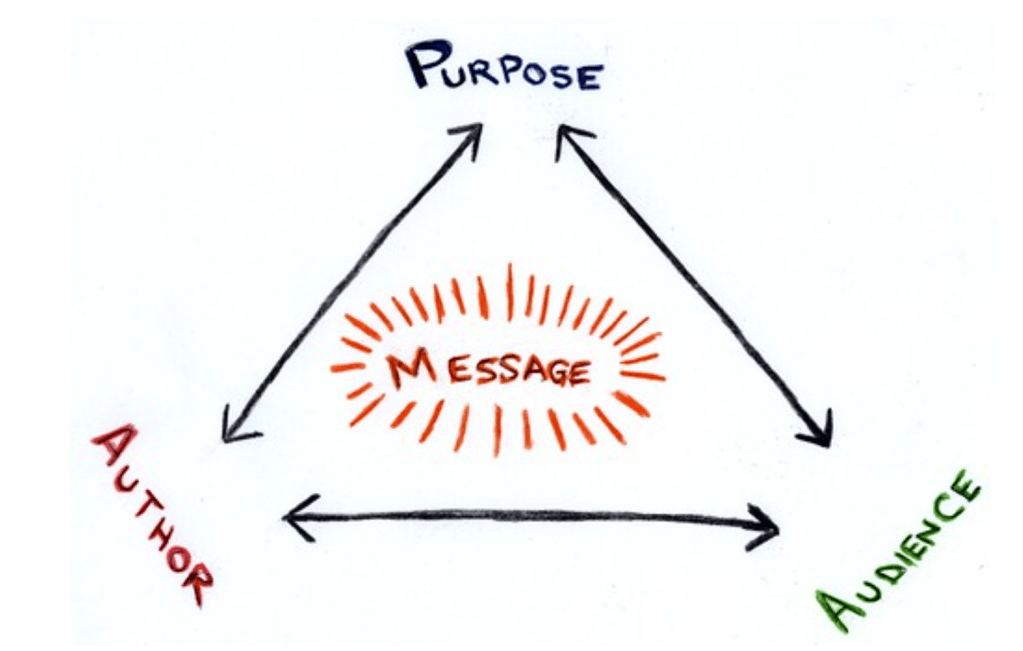
When we have a known audience, we are speaking to a person or a group of people with whom we have some sort of connection. We may know them personally, or we may not, but we have some sort of connection. We may know them personally, or we may not, but we understand that they are part of a group that is familiar with the topic we are presenting as so we can assume that they are familiar with some basic information. When we have a known audience, we have a clearer understanding of what information this group is already familiar with, and what information they still need to know. We can tailor our message to them more specifically- knowing what to leave out and what to put in.
When we have a multiple audience, we start off with a familiar, known audience. However, in this case there is the chance that a larger group of people may come across the text we are writing, and we may not know just how much they are familiar with the issues presented in our text. For example, if we are working on a project for our job, our direct supervisor probably knows the details concerning this project. If we are writing a memo to update them on the progress of that project, we can use terms and abbreviations that they will understand. However, if our supervisor is then going to send that memo to perhaps the owner of the company (especially if it is a larger company with many teams and many projects being done) the owner may not be familiar with all of the terms and details and may need more context information to understand what is going on. In the case of a multiple audience, a text may be written for one person or group, but with the understanding that more people may come across it. More explanation is needed in this case so everyone can understand the message of the text.
The third type of audience is the unknown audience. This is where we as the writer may not be familiar with our audience and we may not know exactly what information they are already aware of. In this case, we want to make sure that we provide as much context information in our text so that our audience knows what we are talking about and what position we are taking. We want to provide as much background information as possible so they understand the issue and where we are coming from.
STANCE
Stance refers to where a person stands on a topic- their position on a topic. If they were in a debate or argument, what side would they be taking? We should be letting our reader know how we feel about the issue we are discussing. We do not always have to completely agree or disagree with something; sometimes we can present different sides and express the merits of all. But usually, we are taking a side in an argument and supporting a particular position.
Stance is not just about taking sides, however. It also reflects a writer’s attitude towards topic-how they feel about it. For example, they can feel: objective, critical, opinionated, curious, passionate, indifferent,etc. They might have a strong opinion on something, may be supporting it or critiquing it, or may be simply, objectively stating facts about it. We can pick up how a reader feels about their subject based on what words they use in their writing. Are they using positive words, negative words, or objective words when discussing the issue? This is another aspect of stance that we find in writing. We want our readers to know our position on a topic as well as how we feel about that topic.
RHETORICAL SITUATION
There are many explanations for what makes up the Rhetorical Situation- but with no one official definition. However, the general idea for this concept is that it is a situation that requires a response- it is something that happens that we decide to write about. A basic example of this could be a sports game. Someone attends this game and then writes about it, whether it is a personal social media post, or perhaps an article for a local news source. The game happened, which is why it is being written about. The game is now the rhetorical situation. An assignment can also serve as the rhetorical situation. A prompt was handed out in class and students need to write an essay in response to that prompt. It is the reason why they are writing; therefore, it serves as the rhetorical situation.
A more specific (and widely taught in composition classes) definition of a rhetorical situation can be taken from rhetorician Lloyd Bitzer (https://en.wikipedia.org/wiki/Lloyd_Bitzer) in his essay titled “The Rhetorical Situation (https://www.jstor.org/stable/40236733? seq=1#metadata_info_tab_contents) .”
Summing up his point, he states that rhetorical (argumentative) discourse is created due to something happening (something happens and we respond/talk/ write about it). We explain its significance and try to provide methods to fix it.
Rhetorical situations, according to Bitzer, have three components: 1. Exigence. 2. Audience. 3. Constraints.
CREDITS: This lesson has been adapted from Mary Griffith’s writing influences lesson.
IN-CLASS READING
GROUP WORK
INSTRUCTIONS: Divide students into groups of four. Working together, students need to crowd source a Google Doc. and list the following details:
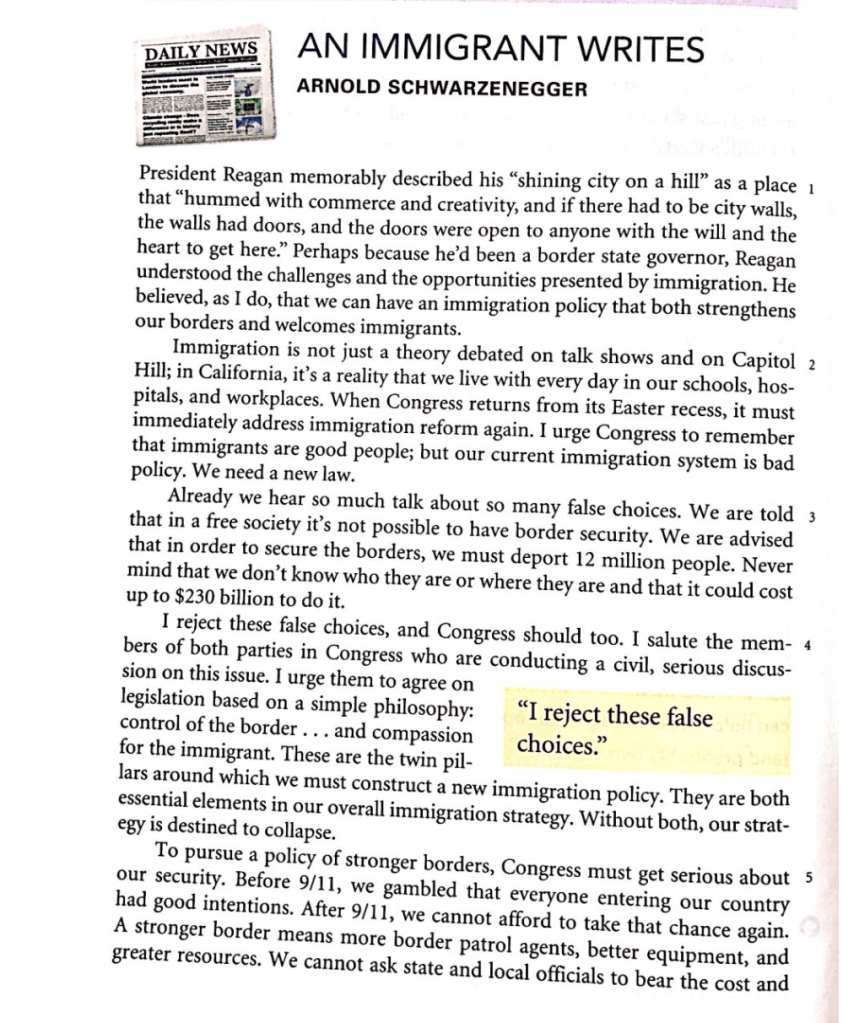
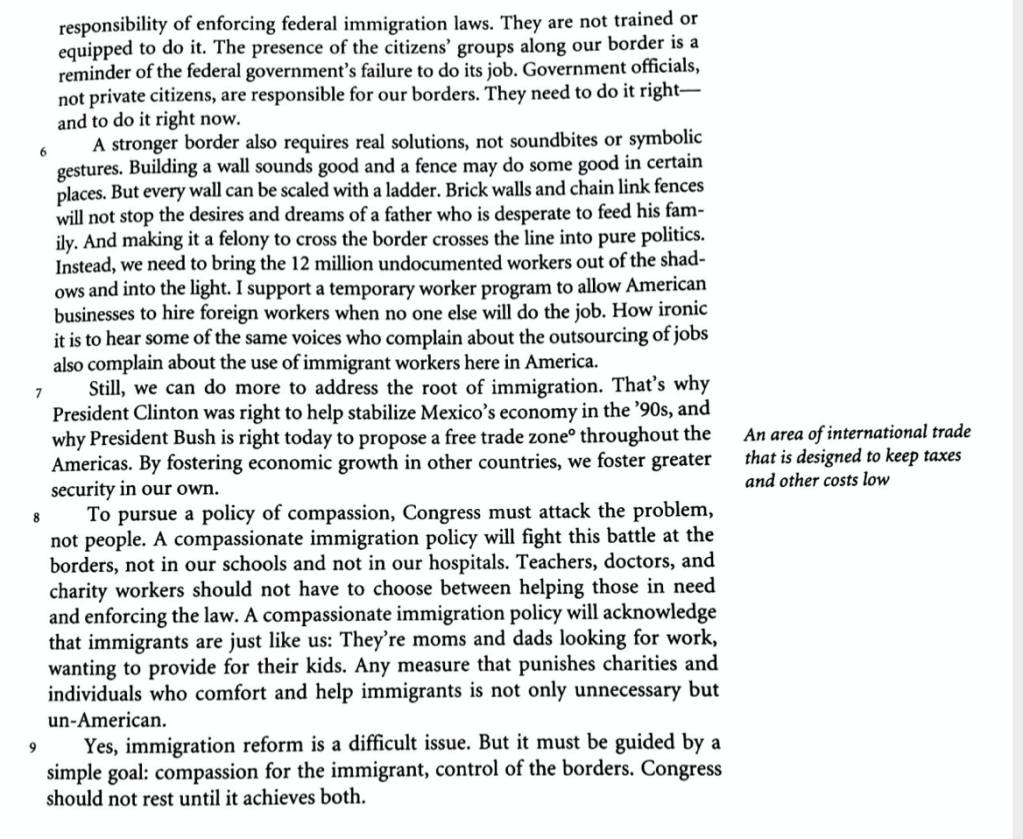
- Who is Arnold Schwarzenegger’s intended audience in this article?
- What is the genre of this writing piece?
- What is the purpose of this article? Inform, entertain, or persuade?
- What is Arnold Schwarzenegger’s stance on immigration?
Be prepare to share your findings with the class.
HOMEWORK
HOMEWORK PART ONE –
Answer the following question: I ask you to write a Twitter post about President Biden’s Address to Congress. What is the rhetorical situation for that Tweet?
HOMEWORK PART TWO –
PROJECT TEXT – WRITING EXERCISE ONE: Using the three scholarly sources you collected from the CSUN database relating to your mythological trickster character, you will create an annotated bibliography using those sources.
For each source you must:
- Create a bibliographic citation (MLA)
- Write a summary of the source (100 words)
- Write an evaluation of the source (100 words)
- Write a description of how you will use the source (100 words)
(See Project Space Lesson Two for Samples of Annotated Bibliographies and Instructions)
 English Writing Studies